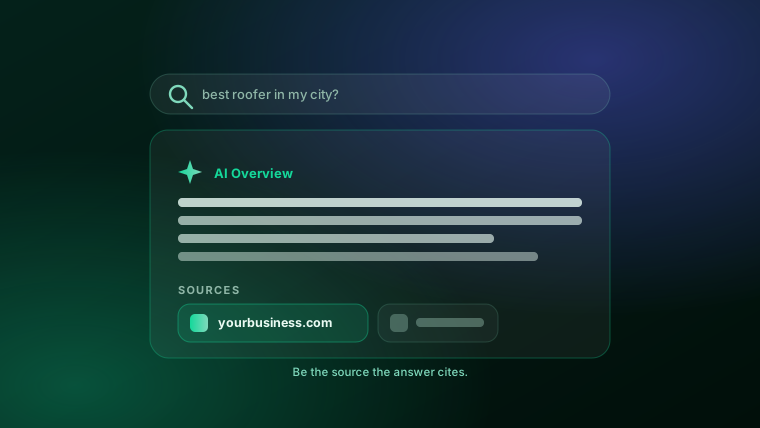
This is the part most builders are still ignoring, and it's exactly why I build the way I do. Search changed. When someone asks Google "how much does a kitchen remodel cost in my city," they increasingly see an AI-written summary first, pulled from several sources with little citation links beside it. ChatGPT and Perplexity do the same thing in a chat window. The question every business owner is now asking: how do I show up there?
The good news is that getting cited isn't a dark art, and it isn't a different skill from good marketing. It's an extension of solid SEO with a sharper focus on answering questions clearly. Here's how it works.
How does AI search actually choose its sources?
An AI answer engine reads many indexed pages, synthesizes a direct answer, and links the sources it leaned on. It picks those sources based on a few honest signals: topical authority (do you cover this subject thoroughly?), content quality and clarity (is the answer specific and easy to extract?), entity clarity (is it obvious who you are and where you operate?), and trustworthiness. There's no secret button. These are the same things that have always made a page genuinely useful.
Which searches trigger an AI answer?
This is the part that calms most local owners down:
- Informational questions ("how to," "what is," "why does") trigger AI Overviews most often.
- Research questions ("how much does a roof replacement cost") are the most affected. Your content either gets cited or skipped.
- High-intent local searches ("HVAC repair near me," "plumber in Harlem") still mostly return the Map Pack, so the part of search that drives calls is largely protected.
So the businesses hurt most by AI Overviews are publishers who lived on "how-to" ad traffic, not local service businesses. For you, the research-phase answer is a chance to introduce your brand before the customer is even ready to call.
How do I get cited? Five concrete moves
- Lead with the answer. Put a direct, specific answer in the first paragraph of the page, then elaborate. AI engines (and busy humans) reward the page that answers immediately.
- Use question-format headings. Make your H2s the exact questions people ask ("How much does a day-of coordinator cost?") and answer each one in a clear paragraph right below.
- Write in natural sentences, not just bullet lists. Answer engines read full, contextual prose. Bullets help, but the connective sentences are what get quoted.
- Be locally specific. Local ranges, neighborhoods, and context are far more citable than generic national filler. "In Harlem, expect…" beats "costs vary."
- Build a real FAQ. A page that answers ten specific questions can be cited across all ten. Deliberate Q&A content is some of the most citable on the web.
I build sites that AI search can actually cite.
Every page ships with direct-answer blocks, FAQ structure, schema, and an llms.txt file: the exact signals ChatGPT, Perplexity, and Google AI Overviews look for.
See plans →Where does Google Business Profile fit in?
Right at the center, still. The Map Pack continues to dominate high-intent transactional searches, so an optimized profile, with the right primary category, reviews, posts and photos, matters as much as ever. And when someone searches your brand name, Google may show an AI-generated business summary; a complete, accurate profile is what feeds that summary the correct information. The winning play is both: a strong profile for transactional visibility, and strong educational content for AI-Overview citations. (New here? Start with our guide to Google Business Profile optimization.)
What not to do
A few honest cautions, because the panic advice online is mostly wrong:
- Don't panic-overhaul local SEO fundamentals that are already working.
- Don't abandon content because "AI will just summarize it." Being the cited source is exactly the point.
- Don't reflexively block AI crawlers. Opting out quietly removes a visibility opportunity.
- Don't write to game the machine. Write for the reader; the citation follows usefulness.
The bottom line
Getting found in AI search isn't a new game. It's the same game with the answer moved to the top. Cover your subject thoroughly, answer real questions directly and locally, keep your Google Business Profile complete, and add the technical signals (schema, FAQ, llms.txt) that make your pages easy to quote. Do that, and when a neighbor asks an AI "who's the best in town," your business is in the answer.
Frequently asked questions
What is AI search?+
When a search engine or chatbot writes a direct answer to your question instead of only listing links. Google AI Overviews, ChatGPT, Perplexity, and Gemini all do this, and they usually cite the sources the answer was built from.
What is answer engine optimization (AEO)?+
Structuring your content so AI answer engines can quote it and cite you as the source. It overlaps heavily with good SEO: clear questions, direct answers, and trustworthy, well-organized pages.
Are AI Overviews bad for local businesses?+
Mostly no. High-intent local searches like "plumber near me" still show the Map Pack. AI Overviews mainly affect research questions, and there the opportunity is to be the cited source, building familiarity before someone is ready to book.
How do I get cited in Google AI Overviews?+
Lead each page with a direct, specific answer to the exact question a customer asks, use question-format headings, write in natural full sentences, be locally specific, and back it with a complete Google Business Profile.
Does my Google Business Profile still matter with AI search?+
Yes, more than ever for transactional searches. The Map Pack still dominates high-intent local queries, and a complete profile feeds the AI summary people see when they search your brand name.
Should I block AI crawlers from my site?+
Usually not. Opting out removes a real visibility opportunity. Unless you have a specific reason to protect content, being eligible to be cited is an advantage.
Do I still get traffic if AI answers the question?+
Being cited is brand exposure even without a click, and the clicks you do get tend to be high quality because the person is deeper in their research.
What kind of content gets cited most?+
Pages that answer a specific question directly and completely: a clear opening answer, a question as the heading, locally specific detail, and a focused FAQ. One page answering ten real questions can be cited across all ten.
Is getting found in AI search different from SEO?+
It's an extension of SEO, not a replacement. The same fundamentals win: topical authority, clear structure, trustworthy content, and schema. AEO just adds a sharper focus on directly answering questions.