What exactly is an AI agent?
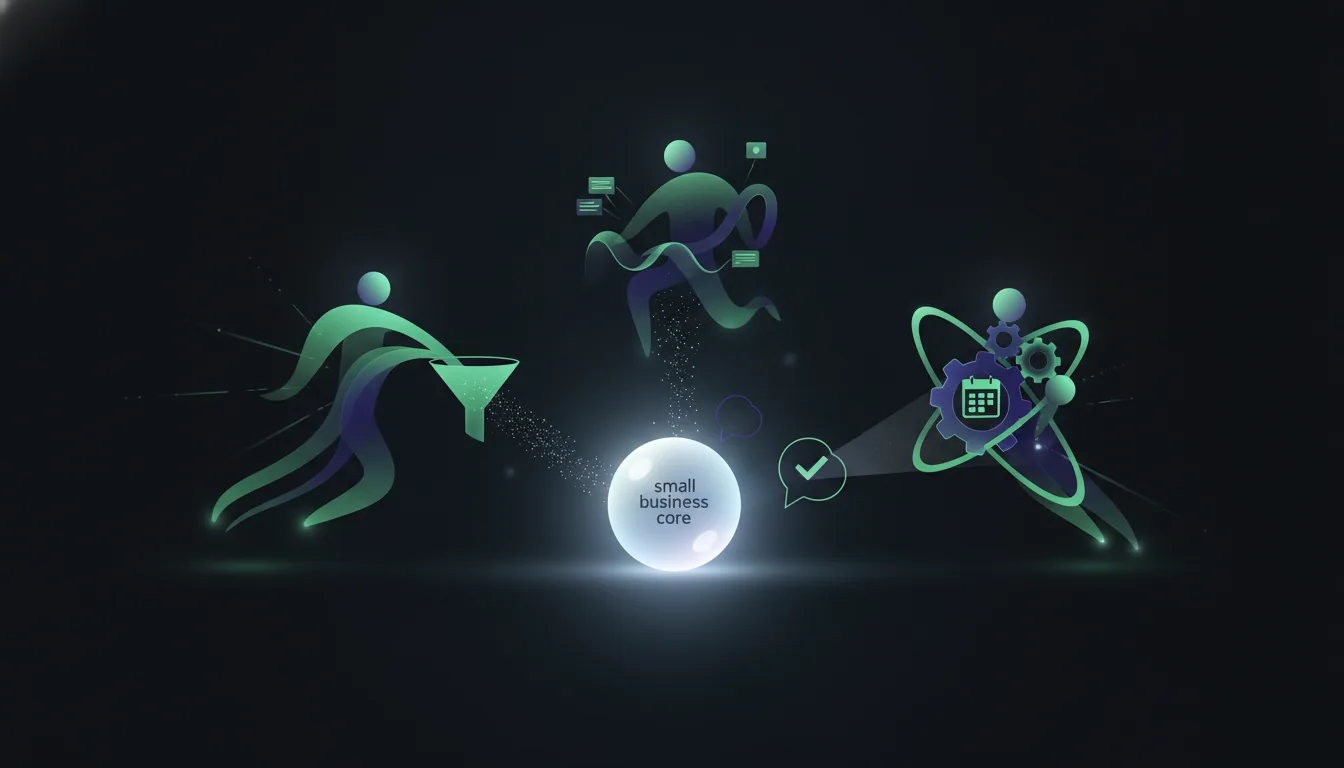
An AI agent is software that perceives its environment, makes decisions, and takes action to achieve specific goals. Think of it as a digital employee that doesn't need step-by-step instructions for every scenario. It observes what's happening, like a new lead filling out a form, a customer asking a question or an appointment getting cancelled, and decides what to do next based on its training and your business rules.
The 'agent' part matters. A calculator waits for you to press buttons. A chatbot responds when someone types. An AI agent initiates. It reaches out to cold leads who haven't responded. It notices a customer visited your pricing page three times and triggers a personalized email. It checks your calendar, finds an opening, and books the appointment without asking permission every time.
This autonomy is what separates AI agents from every other business software you've used. They're built on large language models like GPT-4, but they're wrapped in logic that lets them interact with your CRM, email, calendar, and other tools. They don't just generate text. They execute tasks.
Why should small businesses care about AI agents right now?
Because you're competing against companies with full sales teams, dedicated customer service reps, and marketing departments. An AI agent levels that playing field. It gives a three-person operation in Harlem the responsiveness of a thirty-person team.
Speed wins deals. When a lead contacts you at 9 PM on a Saturday, the business that responds in two minutes gets the appointment. The one that waits until Monday morning gets ignored. AI agents don't sleep, take weekends off, or forget to follow up. They respond instantly, every time, in a tone that matches your brand.
The cost math is simple. A single customer service rep in New York costs $40,000–$55,000 per year plus benefits. An AI agent handling the same volume of inquiries, booking appointments, and qualifying leads costs a fraction of that, and scales instantly when you get busy. You're not replacing humans; you're taking the repetitive work off their plates so they can close deals and build relationships.
How do AI agents actually work behind the scenes?
An AI agent combines three layers: perception, decision-making, and action. Perception means it monitors inputs: new emails, form submissions, chat messages, changes in your CRM, even website behavior. It's watching dozens of signals simultaneously.
Decision-making is where the AI model comes in. The agent takes what it perceives, compares it against your business rules and its training, and decides what to do. 'This lead asked about pricing and lives in our service area, so I should send the estimate template and offer a call.' 'This customer's third invoice is overdue, so I should send a gentle reminder, not the first-notice template.' The agent isn't guessing. It's following logic, but logic flexible enough to handle thousands of variations.
Action is the payoff. The agent doesn't just draft an email and wait for approval. It sends the email, logs the interaction in your CRM, sets a reminder to follow up in three days, and updates the lead's status. It connects to your tools through APIs, the bridges that let software talk to each other. A well-built AI agent can touch every system you use, creating a seamless workflow that used to require a virtual assistant or a custom-coded automation.
What can AI agents do for a small business day-to-day?
Lead qualification is the most immediate win. When someone fills out your contact form, the AI agent asks clarifying questions about budget, timeline and specific needs, and scores the lead. Hot prospects get routed to your phone immediately. Tire-kickers get added to a nurture sequence. You stop wasting time on calls that go nowhere.
Appointment scheduling sounds simple until you factor in time zones, buffer times, double-bookings, and last-minute changes. An AI agent manages your calendar, offers available slots, sends confirmations and reminders, and handles rescheduling requests. It turns a five-email thread into a one-minute interaction.
Customer follow-up is where most small businesses leak revenue. The AI agent tracks every interaction and knows when to reach out. A quote sent three days ago with no response? The agent follows up. A customer who bought six months ago? The agent checks in. A site visitor who downloaded your guide? The agent nurtures them toward a call. It's the persistence you know you need but never have time to execute.
What's the difference between AI agents and chatbots?
Chatbots are reactive and narrow. They wait for someone to type a question, match it against a script or knowledge base, and spit out a canned answer. They live in a single channel, your website chat widget, and they can't do anything outside that bubble. If the conversation goes off-script, they fail gracefully ('Let me connect you with a human') or fail awkwardly ('I didn't understand that').
AI agents are proactive and broad. They operate across channels: email, SMS, CRM, your website, even voice. They initiate conversations based on triggers. They remember context from previous interactions. And crucially, they take action: updating records, sending contracts, processing requests. A chatbot tells a customer your business hours. An AI agent checks your calendar and books the appointment.
The underlying technology often overlaps, since both might use the same language model, but the architecture is different. A chatbot is a single-purpose tool. An AI agent is a platform that orchestrates multiple tasks across your entire business system. If you're only getting a chatbot when you could have an agent, you're leaving most of the value on the table.
What are the biggest benefits AI agents bring to small businesses?
Consistency is underrated. Your best salesperson has off days. They get sick, go on vacation, or burn out. An AI agent delivers the same quality every single time. Every lead gets the same fast response, the same thorough qualification, the same professional tone. Your customer experience stops depending on who's working that day.
Scalability used to require hiring. Now it requires configuration. You land a big partnership that doubles your inbound leads overnight? The AI agent handles it without breaking a sweat. You launch a new service and need to update how you qualify prospects? You adjust the agent's rules once, and it applies that logic to every conversation going forward.
Data capture is the hidden benefit. Humans forget to log calls, skip fields in the CRM, and lose details in the chaos. AI agents document everything automatically. Every interaction, every data point, every next step. It's all recorded. Six months later, you can see exactly how a lead moved through your pipeline, what objections came up, and what closed the deal. That intelligence makes every part of your business smarter.
How much do AI agents cost for a small business?
Pricing models vary wildly. Some platforms charge per agent, $50 to $500 per month depending on complexity and volume. Others charge based on interactions or API calls, which can be unpredictable if you suddenly get busy. Enterprise solutions start at thousands per month and assume you have a developer on staff to configure everything.
For small businesses, the best models bundle AI agents into a broader platform. Meridian, for example, builds AI agents into the same platform as the CRM and the website, so you get all three working together without stitching together five different subscriptions. You're paying for the outcome (more leads converted, faster response times), not for access to raw AI technology you have to figure out yourself.
DIY options exist, like Zapier plus ChatGPT API access, but they require technical skill and constant maintenance. You'll spend hours building workflows, debugging failures, and updating prompts. For most small business owners, that time is better spent serving customers. The cost of a ready-made solution is almost always cheaper than the opportunity cost of building your own.
What mistakes do small businesses make when adopting AI agents?
Expecting magic on day one. AI agents need configuration. You have to teach them your business rules, connect them to your systems, and refine their responses based on real interactions. The businesses that succeed treat the first month as a training period. They review conversations, tweak prompts, and adjust triggers. The ones that fail expect to flip a switch and never look back.
Over-automating before you have process clarity. If your sales process is chaos, with no standard qualification questions, no clear handoff between marketing and sales, and no defined follow-up cadence, an AI agent will just automate the chaos. Fix your process first, even if it's a simple one. Document it. Then let the agent execute it consistently.
Hiding the AI or apologizing for it. Customers don't care if they're talking to a human or an agent. They care about getting their question answered and their problem solved. Lead with value. 'I can check availability and get you scheduled in the next 60 seconds' beats 'Sorry, you're talking to a bot.' Transparency is fine ('I'm an AI assistant'), but don't treat it like a limitation.
Are AI agents practical for local and service-based businesses?
Extremely. Local businesses live and die by responsiveness. A plumber who answers at 7 AM on Sunday books the emergency call. The one who checks voicemail Monday afternoon loses it. An AI agent makes every small business feel like a 24/7 operation, even if you're a solo operator or a small crew.
Service businesses have repetitive qualification questions that AI agents handle perfectly. 'What's your address? What's the issue? When do you need someone there? Have you worked with us before?' The agent collects all that information, checks if you serve the area, gives a ballpark quote if possible, and books the appointment. You show up with everything you need to know.
Neighborhood context matters, especially in a place like New York. An AI agent for a Harlem HVAC company can be trained to know building types (brownstones vs. high-rises), common issues (old radiators, window units), and local references. It doesn't sound like a generic bot. It sounds like someone who knows the area. That's a configuration choice, not a technical limitation.
How long does it take to get an AI agent up and running?
For a pre-built solution like Meridian's AI agents, you can be live in a day. You connect your CRM, set your business hours and service area, write a few example responses, and turn it on. The agent starts handling inquiries immediately, and you refine it over the first week as you see real conversations.
Custom-built agents take weeks to months, depending on complexity. If you're integrating with legacy systems, building custom workflows, or training the agent on thousands of past interactions, expect a longer timeline. Most small businesses don't need that level of customization out of the gate. You need something that works this week, and you can layer on sophistication as you grow.
The learning curve is shorter than you think. If you can write an email, you can configure an AI agent. You're not coding. You're teaching it how you want it to talk and what actions to take. The businesses that get value fastest are the ones that start simple, launch quickly, and iterate based on real feedback.
Can AI agents integrate with the tools small businesses already use?
The good ones integrate with everything that matters: your CRM, email platform, calendar, payment processor, and website. Integration happens through APIs or native connectors. Meridian's AI agents, for instance, are built into the same platform as your CRM and website, so there's nothing to connect. They share data automatically.
Third-party integrations are common for popular tools. Google Calendar, Stripe, QuickBooks, Mailchimp, Slack: most AI agent platforms support these out of the box. If you use something obscure, check compatibility before committing. A powerful AI agent that can't talk to your core systems is just an expensive toy.
Zapier and Make (formerly Integromat) can bridge gaps, but they add complexity and cost. Every connection is another thing that can break. The cleanest setup is an AI agent that lives inside a platform you're already using for other functions. Fewer logins, fewer bills, fewer points of failure.
Ready to get found and get the call?
AI agents for your business, starting with the $1,000 assessment.
See pricing →An honest word
AI agents are powerful, but they're not set-it-and-forget-it. They need your input to understand your business, and they get better as you refine them. We can't guarantee they'll never make a mistake, because they're software and edge cases happen, but we can promise they'll handle repetitive tasks faster and more consistently than manual processes. If you're not seeing clear value in the first 7 days, we'll refund you and help you figure out what didn't work.
Frequently asked questions
Do I need technical skills to use an AI agent?+
No. Modern AI agents are configured through plain-English prompts and simple forms. If you can write an email and fill out a web form, you can set up an AI agent. You're teaching it what to say and do, not writing code.
Will customers know they're talking to an AI?+
Only if you tell them, and light transparency is smart ('I'm an AI assistant and can help you right now'). Most customers care about speed and accuracy, not whether a human typed the response. If the agent solves their problem in 60 seconds, they're happy.
Can an AI agent replace my entire sales team?+
No. AI agents handle repetitive tasks like qualification, scheduling and follow-up, so your sales team can focus on closing and relationship-building. Think of agents as your best junior rep who never sleeps, not a replacement for human expertise and judgment.
What happens if the AI agent doesn't know the answer?+
A well-configured agent escalates to a human. It should recognize when a question is outside its scope and hand off gracefully: 'Let me connect you with someone on the team who can help with that.' You define those escalation rules during setup.
Are AI agents secure with customer data?+
Reputable platforms encrypt data in transit and at rest, comply with privacy regulations like GDPR and CCPA, and let you control what data the agent can access. Always check a provider's security practices and certifications before connecting sensitive systems.
Ready to get found?
Every engagement starts with the $1,000 assessment, credited in full toward whatever's next.
Start the $1,000 assessment →