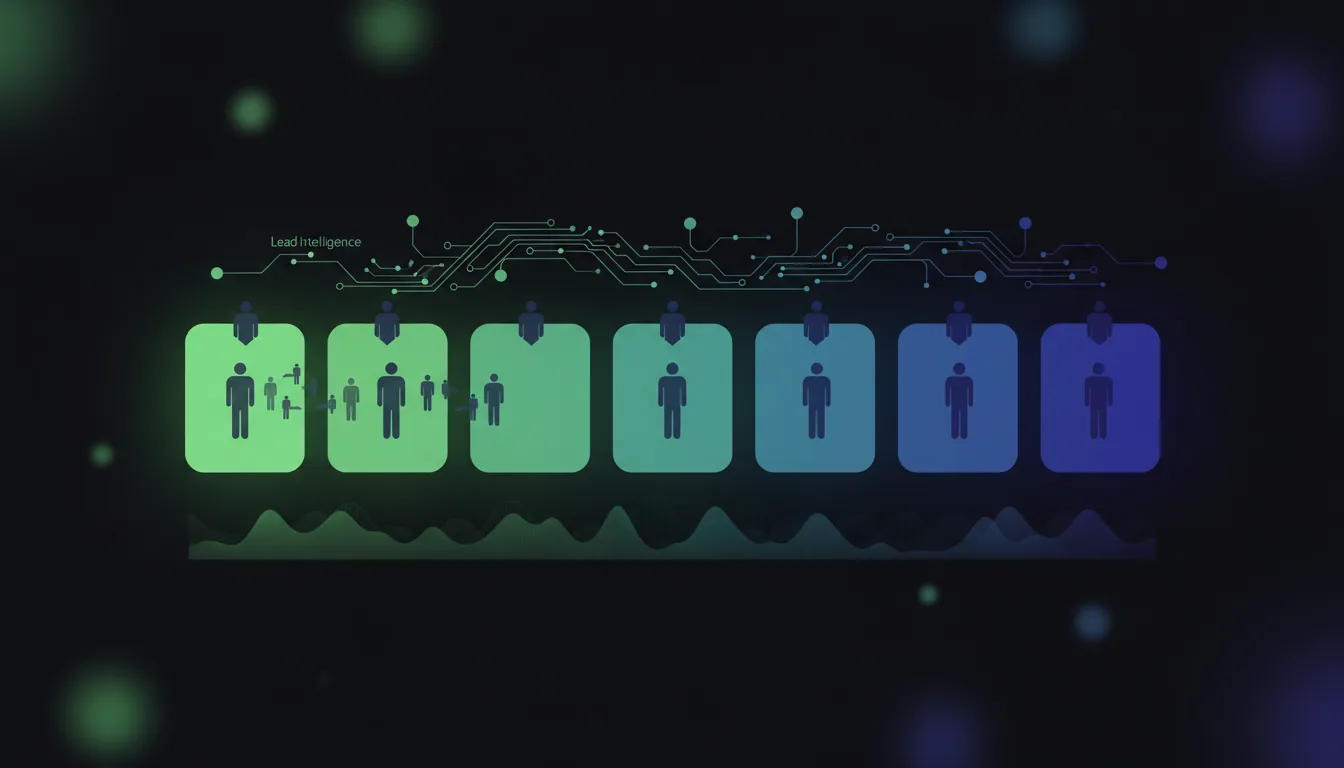
What is AI lead scoring and how is it different from traditional lead scoring?
AI lead scoring applies machine learning algorithms to evaluate and rank your prospects based on dozens of signals: page views, time on site, content downloads, email opens, firmographic data, and behavioral patterns. Instead of manually assigning point values to actions like a human would ('10 points for a pricing page visit'), the AI identifies patterns across thousands of interactions and learns which combinations actually predict a sale. It gets smarter over time as it ingests more data from your closed deals and dead ends.
Traditional lead scoring relies on static rules you set once and forget. You decide a demo request is worth 50 points and a blog read is worth 5 points, then hope your assumptions hold true. The problem? Your gut feeling about what matters rarely matches reality, and those rules go stale the moment your market shifts or you launch a new product. AI scoring adapts continuously, weighing hundreds of variables you'd never track manually and surfacing leads that don't fit your stereotype but convert anyway.
The practical difference for a small business: you stop chasing every tire-kicker and start calling the prospects who are actually ready to buy. Your close rate climbs because you're working warm opportunities, not cold guesses. For service businesses especially, such as HVAC contractors, law firms and consultants, this means your limited sales time goes to the small share of leads that generate most of your revenue.
How does website visitor identification actually work?
Website visitor identification, sometimes called de-anonymization or reverse IP lookup, matches the IP address of a site visitor to a known business entity. When someone from a company network visits your site, their IP often resolves to that company's registered address. The software cross-references this against databases of business IP ranges, firmographic records, and public registrar data to return the company name, industry, size, location, and sometimes even technology stack.
Here's what it does not do: identify individuals by name unless they fill out a form or log in. You'll see 'Acme Consulting visited your pricing page for 4 minutes' but not 'Jane Smith from Acme viewed your site.' Privacy laws and technical reality both prevent person-level tracking of anonymous visitors. The exception is when someone arrives via a tagged email link or fills out a form. Then you can connect the company visit to a known contact.
The value is in knowing which businesses are interested before they reach out. If a 200-employee architecture firm in Brooklyn spent ten minutes on your case studies page, that's a signal worth acting on. You can research the company, find the right decision-maker on LinkedIn, and send a personalized note referencing the content they consumed. It turns passive website traffic into an outbound lead list, which is gold for B2B and high-ticket local services.
Why should small businesses care about AI lead scoring right now?
Because you're drowning in fake leads and bots, and your time is the scarcest resource you have. Form submissions are noisier than ever: competitors snooping, offshore spam, job seekers, students doing 'research.' AI lead scoring cuts through that noise by evaluating behavior, not just a single form fill. A lead that visited five pages over three sessions, opened two emails, and works at a company in your target vertical scores higher than someone who filled out a form once and vanished. You stop wasting follow-up calls on garbage.
The second reason is that buyer behavior has changed. People don't call you the moment they have a need. They research anonymously for days or weeks, compare options, read reviews, lurk on your site. By the time they contact you, they've often already decided. Visitor identification lets you enter the conversation earlier, while they're still evaluating, so you're not just another quote in a spreadsheet. You become the helpful expert who reached out at the right moment.
For NYC small businesses competing against bigger players with sales teams, AI lead tools level the field. You get enterprise-grade intelligence about who's interested, how interested, and what they care about, without hiring a business development rep. A Harlem-based consultancy or a Queens HVAC company can operate like a much larger firm, prioritizing the opportunities that actually pay the bills and ignoring the rest.
What data points does AI lead scoring actually analyze?
Behavioral signals come first: pages visited, session duration, repeat visits, scroll depth, video plays, PDF downloads, email opens and clicks, form submissions, chat interactions. The AI watches how a lead moves through your content. Do they skim blog posts or spend six minutes reading a case study? Did they visit your pricing page three times in a week? Behavior reveals intent better than demographics ever will.
Firmographic and demographic data layer on top: company size, industry, revenue, location, job title, seniority. For B2B, a lead from a 500-person company in your service area scores differently than a solo freelancer halfway across the country. For local businesses, geographic proximity and service-area fit matter enormously. A plumber in Manhattan doesn't care about a site visitor in Montana, no matter how engaged they seem.
Engagement recency and frequency round it out. A lead who visited yesterday is hotter than one who visited three months ago. Someone who's returned five times in two weeks is signaling active buying intent. The AI weighs timing and patterns, not just totals. It distinguishes between a prospect binge-reading your content in one session versus someone steadily researching over weeks, and scores them accordingly. Meridian's CRM with AI agents ingests all these signals automatically, so you see a single lead score without building spreadsheets or integrations.
How do I actually use lead scores and visitor data without being creepy?
Lead scores are internal prioritization tools. They tell you who to call first, not what to say to the prospect. You don't open a conversation with 'I see you scored 87 points in our system.' Instead, you reference the content they engaged with: 'I noticed you checked out our guide on local SEO for law firms. Are you looking to improve your visibility in Brooklyn?' You're being helpful and relevant, not surveilling.
Visitor identification works the same way. If you see a commercial real estate firm visited your site, you research them, find a relevant contact, and send a personalized note. You might say, 'Saw your firm is expanding in Harlem. We help property companies show up in local search when tenants are looking. Worth a quick call?' You're using the signal to start a conversation, not to prove you were watching. The line between helpful and creepy is whether you add value or just reveal that you were tracking.
Transparency matters. If someone asks how you found them, be honest: 'We use software that shows us which companies visit our site, and your firm came up. Figured I'd reach out since we work with a lot of businesses like yours.' Most B2B buyers expect this now. It's standard practice, not a secret. For consumer-facing businesses, tread lighter; focus on inbound behavior like form fills and email engagement rather than cold outreach based solely on a site visit.
What's the difference between lead scoring software and a full CRM with AI agents?
Standalone lead scoring tools, such as Leadfeeder, Clearbit Reveal and Albacross, identify visitors and score leads, then hand you a list or push data into your existing CRM via integration. You still need to manually review the list, research the companies, draft emails, log calls, and follow up. They're powerful but passive; they give you intelligence, not action. You're the one who has to do something with it, and if you're busy running the business, that list just piles up.
A CRM with AI agents, like Meridian's, goes further. The AI doesn't just score and identify. It can draft personalized outreach, send follow-up sequences, qualify leads via chat or email, update records, and surface the hottest opportunities in a daily digest. It acts on the intelligence, not just reports it. Think of it as a junior sales rep who never sleeps, working your lead list while you're installing HVAC units or meeting with clients.
For small businesses, the difference is whether the tool saves you time or creates more work. A scoring tool that dumps 50 company names on you every week is only useful if you have the discipline and capacity to work that list. An AI agent that reaches out to the top 10, qualifies interest, and books meetings on your calendar is a revenue driver. Meridian's platform combines both: visitor ID and scoring built into a CRM with agents that actually follow up. That way the intelligence turns into conversations without you lifting a finger.
Can AI lead scoring work for local service businesses or just B2B SaaS?
It works brilliantly for local services, but the signals you score are different. A plumber or personal injury lawyer cares less about job titles and company size, more about geographic proximity, service intent, and speed to contact. The AI should score a visitor who viewed your 'emergency repair' page in your service area higher than someone who read a blog post from another state. Recency and location become the dominant factors, not firmographics.
Visitor identification is less useful for pure consumer businesses, since you won't identify individual homeowners by IP, but it's powerful for B2B local services. If you're a commercial cleaning company and a 50-person accounting firm in Midtown visits your site, that's a qualified lead worth pursuing. If you're an IT consultant and a law firm in Brooklyn checks out your managed services page, you can reach out directly. The hybrid businesses, serving both consumers and small businesses, benefit most when they filter visitor data for commercial IP ranges.
Lead scoring still applies to form fills and repeat visitors even when you can't identify the company. Someone who visits your site three times, reads your service area pages, and finally submits a contact form scores higher than a one-time visitor who filled out a form and bounced. The AI learns which patterns precede actual bookings, so over time it gets scary good at predicting who's a serious buyer versus a price shopper. Meridian's AI is trained on local service patterns, not just SaaS funnels, so it understands the difference between a quote request and a tire-kicker.
What are the biggest mistakes businesses make with AI lead scoring?
Trusting the scores blindly at the start. AI needs data to learn. If you've only closed ten deals, the model doesn't have enough signal to be accurate. Early on, treat scores as a rough guide, not gospel. Review the leads it ranks highly, give feedback (explicitly marking wins and losses in your CRM), and let the system learn. After a few dozen closed deals, the scores get reliable. Businesses that expect perfect accuracy on day one get frustrated and abandon the tool before it pays off.
Ignoring low-scoring leads entirely. AI is probabilistic, not omniscient. It predicts likelihood, not certainty. A low-scoring lead can still convert, especially if they have an urgent need or a personal referral you don't know about. Use scores to prioritize your time, not to disqualify people. Call the high scorers first, but don't delete the low scorers. Set up a nurture sequence for them and revisit in a month. The worst mistake is treating a score as a binary yes/no instead of a priority ranking.
Failing to update your scoring model when your business changes. Launch a new service? Your AI needs to learn which behaviors predict interest in that offering. Expand to a new borough? Geographic scoring should adjust. Shift from residential to commercial clients? Firmographic weights need to change. The best systems let you retrain or adjust weights as your business evolves. Meridian's AI agents adapt as they see which leads you actually close, but you should still review scoring logic quarterly to make sure it aligns with your current strategy.
How long does it take to see ROI from AI lead scoring and visitor identification?
You'll see some value within the first week. Visitor identification starts showing you companies browsing your site immediately, and even a basic lead score helps you prioritize follow-up faster than gut feel alone. But meaningful ROI, meaning higher close rates, shorter sales cycles and more revenue per hour of sales effort, takes a few weeks to a few months, depending on your lead volume and sales cycle length.
If you get 50+ leads a month and close deals in days or weeks (local services, e-commerce, low-ticket B2B), you'll have enough data for the AI to learn patterns within 30 to 60 days. You'll start seeing which scored leads convert, and your team will trust the system enough to let it guide their call list. If you're in a longer sales cycle, such as consulting, commercial real estate or enterprise services, it might take a quarter before you have enough closed deals to validate and tune the model.
The ROI isn't just in closing more deals; it's in not wasting time on bad ones. If AI scoring saves your salesperson (or you) from chasing five dead-end leads a week, that's hours back in your calendar. For a small business owner in Harlem juggling sales, delivery, and operations, those hours are worth more than the software cost. Meridian customers typically see time-to-contact drop and lead response speed improve within the first month, which alone boosts conversion before the AI even gets smart.
Do I need a big website traffic volume for visitor identification to be worth it?
Not as much as you'd think, especially for B2B or high-ticket local services. If even a fraction of your monthly visitors are identifiable businesses, that's a list of companies you didn't know were interested. Even if only five of those are in your target market, that's five warm outbound opportunities you wouldn't have had. For a consultant billing $10k a project or a commercial contractor closing $50k jobs, one converted visitor pays for a year of software.
Consumer-heavy sites with mostly residential traffic see less value. Visitor ID can't identify individual homeowners, so a roofer or wedding photographer won't get much from it unless they also serve businesses. But if you're a locksmith who does both residential and commercial, or a cleaning company that targets offices, the commercial visits alone justify the tool. Filter for business IP ranges and ignore the rest.
Higher traffic obviously gives you more at-bats, but quality beats quantity. A niche B2B site with 200 monthly visitors from decision-makers is more valuable than a blog with 10,000 random readers. Meridian's platform is built for small businesses, so the visitor ID and scoring work even at modest traffic levels. We're not optimizing for venture-backed SaaS companies with 100k monthly uniques. If you're driving local search traffic or targeted ads, you have enough volume to benefit.
How does AI lead scoring fit into a CRM workflow for a small team?
The CRM should surface high-scoring leads automatically, with no hunting through lists. Meridian's dashboard shows you a prioritized feed every morning: 'These five leads are hot, here's why, here's what they viewed.' You click, see the context, and make the call or send the email. The score does the triage so you don't spend 20 minutes every day deciding who to contact first. For a solo operator or a two-person team, that's the difference between structured follow-up and chaos.
AI agents take it further by acting on scores without you. A high-scoring lead who hasn't responded to your initial email gets an automatic follow-up two days later. A medium-scoring lead goes into a nurture sequence with helpful content. A visitor identified as a target company gets a personalized outreach email drafted by the AI and queued for your review. You approve or edit with one click, and it sends. The CRM becomes a co-pilot, not a database you have to remember to check.
Integration with your existing tools matters. If you're already using a CRM, lead scoring should push scores and visitor data into it via API, with no double entry. If you're starting fresh, choose a platform like Meridian where scoring, visitor ID, and CRM are native to each other. The worst workflow is logging into three tools to see who visited your site, what their score is, and where they are in your pipeline. Everything should live in one place, updating in real time, so you're working from a single source of truth.
What should I look for in an AI lead scoring and visitor identification platform?
Accuracy of visitor identification first. Some tools identify a sizable share of your B2B traffic, others much less. Ask what databases they use, how often data refreshes, and whether they cover your geography. Some tools are US-heavy and miss international or small local businesses. Test it: install the tracking code and see how many of your known customer companies it catches when they visit. If it's missing obvious ones, the data quality isn't there.
Transparency in scoring logic. Black-box AI that won't explain why a lead scored high is frustrating and hard to trust. Look for platforms that show you the contributing factors: 'This lead scored 82 because they visited pricing twice, opened three emails, and match your target industry.' You should be able to give feedback ('this lead closed' or 'this was junk') so the model improves. Meridian's AI agents learn from every outcome you log, and you can see which signals drove each score.
Ease of action. Data without workflow is useless. Can you click a button to email a high-scoring lead, or do you have to export a CSV and draft something in Gmail? Does the platform integrate with your phone system so you can call from the CRM and log the outcome? Can you set up automations, like 'When a lead hits 80 points, notify me and send them this email,' without hiring a developer? The best platforms turn insight into action in one or two clicks, not ten steps across three tools.
Ready to get found and get the call?
Lead scoring + visitor ID, starting with the $1,000 assessment.
See pricing →An honest word
AI lead scoring and visitor identification give you better intelligence, but they don't make sales calls for you or force a prospect to buy. We can show you which companies visited your site and which leads are most likely to convert, but closing still depends on your offer, your follow-up speed, and your sales process. The AI gets smarter over time as it learns from your wins and losses. Expect a few weeks to a few months before scores feel truly dialed in. Cancellation and refunds are exactly as stated in the Refund Policy. No ranking promises, no fake urgency, just tools that work if you work them.
Frequently asked questions
Can AI identify individual website visitors by name?+
No. Visitor identification reveals which companies visited your site based on IP address, not individual people, unless that person fills out a form or clicks a tagged email link. Privacy laws and technical limits prevent person-level tracking of anonymous visitors.
How accurate is AI lead scoring for small businesses with limited data?+
Early on, scores are rough. AI needs a few dozen closed deals to learn reliable patterns. Treat scores as prioritization guides, not certainties, and give feedback by marking wins and losses. Accuracy improves significantly after 30 to 90 days of real outcomes.
Do I need to integrate multiple tools or is it built into Meridian?+
Meridian's CRM includes native AI lead scoring, visitor identification, and AI agents in one platform, with no separate subscriptions or integrations required. If you use another CRM, many scoring tools can push data via API, but you'll manage multiple logins.
Is visitor identification legal and privacy-compliant?+
Yes, when done correctly. Business IP-to-company matching uses publicly available data and doesn't identify individuals, so it's compliant with GDPR, CCPA, and other privacy laws. Always disclose tracking in your privacy policy and respect opt-outs.
What's a good lead score threshold to prioritize for follow-up?+
It depends on your volume and capacity. Start by calling the top 20% of scored leads first and track close rates. Adjust the threshold up if you're overwhelmed or down if you have capacity. Most teams find a natural cutoff, often around the 70th percentile, where conversion rates visibly jump.
Ready to get found?
Every engagement starts with the $1,000 assessment, credited in full toward whatever's next.
Start the $1,000 assessment →