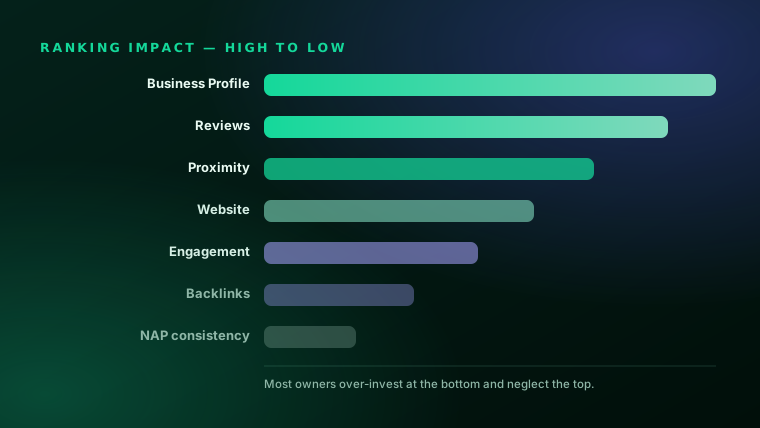
I'll give this to you straight, the way I would to a neighbor. Search "best [your service] near me" and you'll find a hundred checklists promising to fix your rankings. The trouble is they list thirty factors as if they all matter the same. They don't, and chasing the wrong ones is why so many owners "do SEO" for months with nothing to show. Here's an honest ranking, ordered by what actually moves the Map Pack.
What actually determines local rank?
Google has said local ranking comes down to three things: relevance (how well you match the search), distance (how close you are), and prominence (how well-known and trusted you are). Almost every real factor below is just a lever under one of those three. Pull the high-impact levers first.
Tier 1: the factors that move the needle most
#1: Google Business Profile relevance & completeness
The single most impactful thing you control. Your primary category is the most heavily weighted field in the entire profile. "Florist" and "Wedding Florist" rank for different things, so choose deliberately. Then fill every field: hours, services with natural-language descriptions, attributes, products, and real photos. Complete, active profiles beat thin ones.
#2: Reviews, by volume, rating, and recency
Aim for a strong average (4.5+), but recency matters more than people realize: eight reviews in the last month signals a thriving business more than two hundred from three years ago. Ask every customer, and respond to every review, because replying is itself a trust signal. (Never gate reviews to only happy customers; that violates Google's policy.)
#3: Proximity to the searcher
For a fixed storefront, your address sets this and you can't change it. If you're a service-area business, the controllable move is setting every ZIP code you actually serve, accurately. Beyond that, proximity is Google's call, which is exactly why you win on the levers you can control.
Tier 2: website & engagement
A relevant, locally focused website reinforces your profile. The fundamentals: a location page with an "[Service] in [City], [State]" heading, individual pages for each core service, and substantive content. Then there are engagement signals: a high-quality cover photo that earns clicks, people requesting directions, branded searches for your name. These are real signals you earn by being genuinely findable and useful, not something to manufacture.
Tier 3: backlinks
Links from other reputable, ideally local sites still help, such as local news coverage, a sponsorship listing, a relevant association. But relevance beats volume: one trusted local link outweighs dozens of junk directory listings. This is a "nice to have once Tiers 1–2 are solid," not a starting point.
Tier 4: NAP consistency (the overhyped one)
Yes, your Name, Address, and Phone should be correct and reasonably consistent. But Google understands that "Joe's Plumbing" and "Joe's Plumbing LLC" are the same business. Fix genuine errors, like a wrong number or an old address, and then stop. The people spending entire weeks scrubbing minor formatting differences across fifty directories are polishing Tier 4 while ignoring Tier 1.
Want Tier 1 handled for you?
I optimize your Google Business Profile, including category, services, posts and reviews, alongside a locally relevant website, so your time goes where it counts.
See plans →Where to actually spend your time
- Get your Google Business Profile complete, with the right primary category, every field, weekly posts.
- Build reviews consistently, with high ratings, and respond to all of them.
- Set your service area correctly for every ZIP you serve.
- Strengthen your website with a real location page and a page per service.
- Earn a few relevant local links.
- Fix only major NAP errors.
The bottom line
The reason most local businesses stall isn't a lack of effort. It's effort aimed at Tier 4 while Tiers 1 and 2 sit half-done. Fix the order. Get the profile right, gather recent reviews, back it with a relevant website, and you'll move in the searches that actually bring calls. (New to the profile side? Start with our Google Business Profile optimization guide.)
Frequently asked questions
What are the most important Google local ranking factors?+
In order of real impact: a complete, well-categorized Google Business Profile; your reviews; proximity to the searcher; your website's local relevance; genuine engagement signals; backlinks; and, far less than people assume, NAP consistency.
What's the single most important factor I can control?+
Your Google Business Profile primary category. It's the most heavily weighted single field, so it must match the work you most want to be found for.
How important are reviews?+
Very. Rating, total volume, and especially recency all matter. A steady stream of recent reviews signals an active, trusted business more than a large pile of old ones.
Can I control proximity to the searcher?+
Not really for a fixed address. A service-area business can set the exact areas it serves, but physical distance is something Google decides, not you.
Does my website affect my local ranking?+
Yes. A relevant, locally focused website with clear service pages reinforces the relevance and prominence of your profile, the two factors you can actually influence.
How important is NAP consistency?+
Less than most guides claim. Fix genuine errors like a wrong phone or old address, but Google understands minor formatting differences. Don't spend your week on directories while neglecting your profile and reviews.
How do I rank in the Map Pack?+
Complete your profile with the right primary category, gather recent reviews consistently, post and add real photos, and back it with a relevant local website. Those moves, in that order, do most of the work.
How long does it take to improve local rankings?+
Fixing a primary category can help within days. Building review volume and prominence usually takes one to three months of consistent activity.