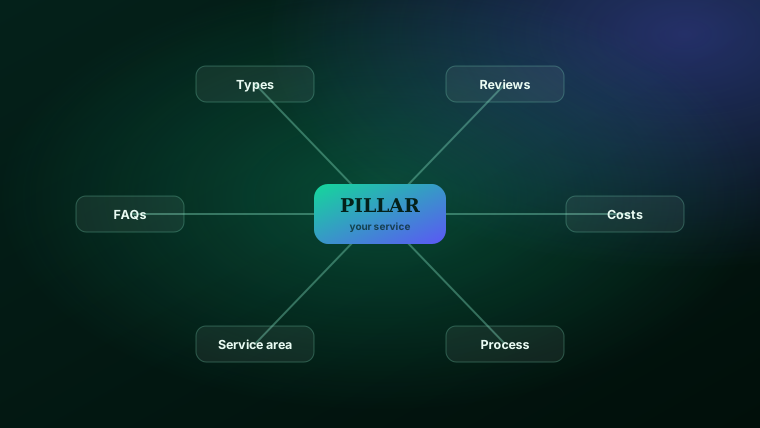
This is one of my favorite things to build for a business, because it's how the smaller guy wins. Most small-business owners are told to "post more content." So they write a few thin blog posts, see nothing happen, and give up. The problem isn't effort — it's structure. Google doesn't reward a pile of unrelated pages; it rewards a site that comprehensively covers a subject. That coverage is called topical authority, and it's the single best way for a smaller business to out-rank a bigger one.
What is topical authority, really?
Think of it the way you'd think about a specialist versus a generalist. If a website covers one field deeply — the service, the variations, the process, the costs, the common questions — search engines treat it as an authority on that field and surface it for many related searches. Cover a subject shallowly and you compete for scraps. The good news: this doesn't take thousands of pages. It takes a deliberate structure applied consistently.
Why it beats "just having more pages"
One substantive, specific page will out-rank five thin, generic ones — and, more importantly, every page you add to a topic strengthens the others around it. Authority compounds. That's why ten connected pages on one subject beat fifty scattered pages on ten subjects. Depth, not breadth.
Step 1 — Build one pillar page per service
Start with a single comprehensive page for each major service you offer (not one page for your whole business). A good pillar page runs 800–1,500 words and covers the service category, the types of work, who it's for, your process, and why your location matters. Make the heading specific: "[Service] in [City], [State]." The pillar is the hub — it links out to everything below it.
Step 2 — Surround each pillar with clusters
Cluster pages cover the subtopics of the pillar in depth. For a roofer, a "Roofing Services in Austin" pillar might be surrounded by clusters like storm damage repair, how long a roof lasts in Texas, signs you need a new roof, and how much a roof replacement costs in Austin. Each cluster links back to the pillar; the pillar links to each cluster. That's the structure search engines read as expertise.
Step 3 — Answer every customer question
List the twenty questions customers ask you before, during, and after a job. Each one is a content opportunity — and a chance to get cited in AI search. Give every question a full section or its own page: two to four paragraphs of specific, genuinely useful answers, written in natural language. A page that answers ten real questions can rank and be cited across all ten.
Don't want to map all this by hand?
I'll build you a complete content plan for your industry — pillars, clusters, and the questions to answer — with my Topic Architecture planner, in minutes.
See plans →Step 4 — Internal links make the cluster work
This is the step everyone skips, and it's what holds the structure together:
- Every cluster page links back to its pillar, using descriptive anchor text about the broader topic.
- Pillar pages link to every cluster page in their topic.
- Related cluster pages link to each other where the topics connect.
- Your homepage links to your primary pillar pages.
One rule: use descriptive anchor text ("how much a roof replacement costs"), never "click here." The links tell search engines how your pages relate — that map is half the authority.
Consistency beats volume
One or two substantive pages a month, maintained over time, beat a burst of twenty pages followed by silence. Update existing pages as your services evolve, watch which clusters gain traction in Google Search Console, and double down on what's working. Topical authority rewards the tortoise.
The bottom line
You don't need a giant website to win — you need a complete one on the subjects you want to own. Build a pillar for each service, surround it with clusters that answer real questions, link it all together, and keep going. That's how a local business earns the authority Google rewards — and how it stays found as search shifts toward AI-generated answers.
Frequently asked questions
What is topical authority?+
Google's assessment of how comprehensively and accurately your website covers a subject — built from how your pages connect and whether, together, they form a complete picture of the field.
How do I build topical authority for a local business?+
Create one comprehensive pillar page per major service, surround each with cluster pages that answer specific questions in depth, link them together, and publish consistently. Structure matters more than sheer volume.
What is a pillar page?+
One comprehensive page covering a whole service category — like "Roofing Services in Austin, Texas." It acts as the hub and links out to every related cluster page.
What is a content cluster?+
A set of pages covering the subtopics of a pillar in depth. Each cluster page links back to the pillar, and the pillar links to all of them.
Do I need thousands of pages?+
No. Topical authority comes from structured, comprehensive coverage — not volume. A focused set of substantive, well-linked pages can out-rank a sprawling site of thin ones.
How is topical authority different from keywords?+
Keyword targeting optimizes one page for one phrase. Topical authority is your whole site demonstrating depth across a subject — which is what lets you rank for many related searches at once.
How many cluster pages should each pillar have?+
Aim for at least five substantive cluster pages per pillar, then keep adding as you answer more real customer questions. Each page you add strengthens the whole cluster.
How long does it take to build topical authority?+
It compounds over months. One to two well-made pages per month, maintained consistently, beats a burst of twenty thin pages followed by nothing.