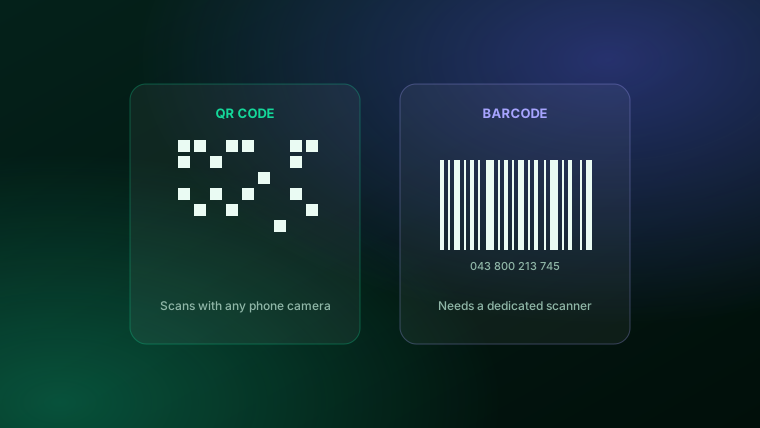
Both are ways to encode information so a machine can read it faster than a person typing it in. Past that, they're built for different jobs, and mixing them up leads to a mismatch — like trying to use a retail barcode scanner setup for a menu, or expecting a printed barcode to open a webpage on someone's phone.
The core difference
| Barcode | QR code | |
|---|---|---|
| Shape | A single line of bars | A two-dimensional square |
| Data capacity | A short number, typically | A full URL, contact card, or block of text |
| How it's read | A dedicated barcode scanner | Any smartphone camera |
| Typical use | Retail inventory, point of sale | Marketing, links, contact info |
| Customizable | Not really — the lines must stay precise | Yes — colors and a logo, without breaking the scan |
Why barcodes still exist
Retail runs on barcodes for a reason: point-of-sale systems, inventory software, and scanner hardware are all built around that exact format, and changing it would mean replacing infrastructure across an entire industry. If you're managing product inventory, barcodes (UPC, EAN, and similar standards) remain the practical choice — that's a different tool for a different job than what a QR code generator is for.
Why QR codes took over marketing
A barcode needs a dedicated scanner. A QR code needs whatever's already in a customer's pocket. That single difference is why QR codes, not barcodes, became the format for menus, flyers, business cards, and signs — anything meant to be scanned by a customer rather than an employee at a register.
The bigger data capacity matters too: a QR code can hold an entire web address, so it can send someone straight to a menu, a booking page, or a contact card — not just a lookup number in someone else's database.
Need a QR code, not a barcode?
Generate custom, trackable QR codes in your brand colors — for menus, flyers, signs, and business cards.
See pricing →Making the choice for your business
- Selling physical products through a retail point-of-sale system? You're using barcodes already, and that's the right call.
- Want a customer to scan something and land on a page, a menu, a booking form, or your contact info? That's a QR code job — see the complete guide to custom QR codes.
- Putting it on a physical sign or listing flyer? Check QR codes for real estate for size and placement specifics.
The bottom line
Neither format is "better" in general — they're built for different jobs. Barcodes run retail inventory. QR codes run the moment a customer's phone connects to your business. If you're deciding which one your next marketing piece needs, the answer is almost always the QR code.
Frequently asked questions
What's the main difference between a QR code and a barcode?+
A barcode stores a short number in a single line and needs a dedicated scanner to read. A QR code is a two-dimensional square that can store much more information — a full web address, contact card, or WiFi login — and scans instantly with any smartphone camera.
Can a QR code hold more information than a barcode?+
Yes, significantly more. A standard barcode typically holds a short numeric string, while a QR code can hold thousands of characters — enough for a full URL, a contact card, or a block of text.
Do I need special equipment to scan a QR code?+
No — any modern smartphone camera can scan a QR code without a separate app. Traditional barcodes usually need a dedicated barcode scanner or a specific scanning app.
Should my business use QR codes or barcodes?+
For marketing — menus, flyers, business cards, signs — use a QR code, since customers can scan it instantly with their own phone. Barcodes remain the standard for retail inventory and point-of-sale systems, which are built around that format.
Can a QR code be customized with colors or a logo?+
Yes — a QR code's colors are just a design choice, so it can be generated in your brand colors with a logo in the center. A traditional linear barcode can't be customized the same way without breaking its readability.